
The AI Bubble Isn't the Story
The MIT NANDA study found 95% of enterprise AI projects deliver no measurable business return. But the same study points somewhere else entirely — and it's not the technology.
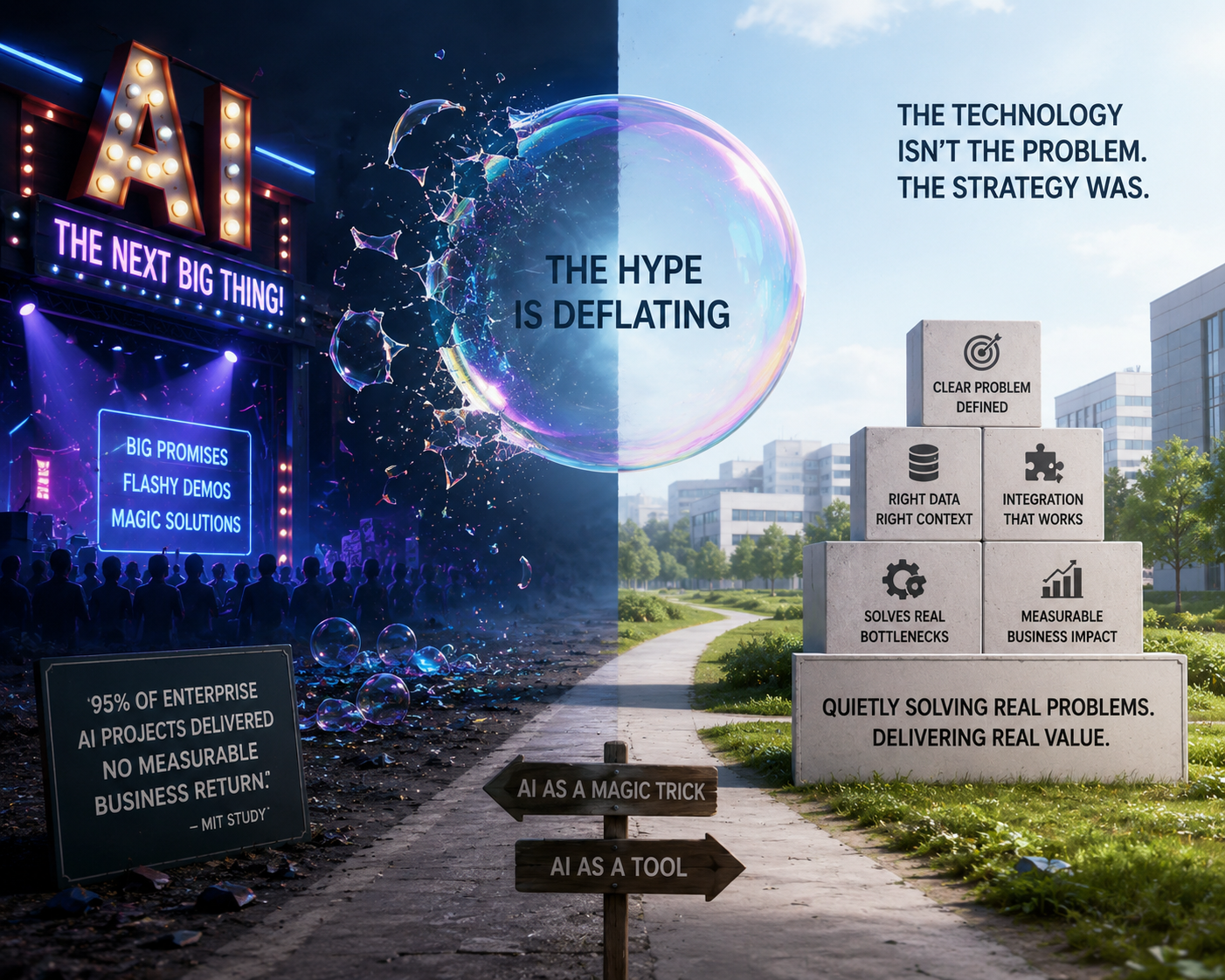
Everywhere you look right now, someone's declaring the AI bubble is about to burst. Funding is pulling back. Headlines announce that "AI hasn't delivered." The dot-com comparisons are everywhere. And one number keeps getting quoted: a July 2025 MIT study found that 95% of enterprise AI projects delivered no measurable business return.
At first glance, that looks like proof AI is failing. But the more I sat with that number, the less it added up to "the technology doesn't work."
But the same report points somewhere else entirely.
What the 95% actually means
The MIT study — The GenAI Divide: State of AI in Business 2025, from MIT's Project NANDA — is blunt about the cause. The divide between the 5% who see real value and the 95% who don't "does not seem to be driven by model quality or regulation, but seems to be determined by approach."
In other words: the models weren't the primary problem. Deployment usually was.
The report backs this up with details that are easy to miss under the headline. Roughly half of AI budgets went to visible, board-friendly sales and marketing use cases — because those are easy to show — while the higher-return work in back-office operations stayed underfunded. Internally built tools failed about twice as often as ones built with external partners. And there's a "shadow AI economy": in over 90% of companies surveyed, employees quietly used personal ChatGPT and Claude to get real work done, even as their company's official AI pilots stalled.
Read together, the picture isn't "AI doesn't work." It's that many companies pointed AI at the wrong problems, in the wrong way.
The theatre, not the technology
That tracks with something I keep noticing. A lot of AI projects over the past two years seemed designed to be seen — a flashy demo, an "AI-powered" announcement, something to show the board the company was "doing AI" — rather than aimed at a real, unglamorous problem.
The projects that quietly work look different. They're rarely the impressive-looking ones. They're aimed at one specific, boring bottleneck — a slow process, a repetitive task, a workflow nobody wanted to touch — and they just do the job. As one manufacturing executive told the MIT researchers, the hype on LinkedIn says everything has changed, but in their operations nothing fundamental had shifted beyond processing some contracts faster.
If that's true, then the difference between success and failure isn't a smarter model. It's clearer intent.
What the 5% actually do
The companies on the right side of that divide don't necessarily have the biggest models or the deepest budgets. What they seem to share is something much less exciting: they start with a real, specific problem — one they can actually measure — and they let AI be one piece of solving it, not the headline.
They know what "working" would look like before they start. They fit the AI into a process people already use, instead of asking people to rebuild their day around it. And when it doesn't move the number they cared about, they change it or drop it — quietly, without a press release. AI ends up as a component of how the business runs, not the thing the business is about.
So — is it a bubble?
Which makes me think what we're seeing isn't a bubble bursting. It might just be the theatre ending — the gap closing between companies that treated AI as a magic trick and companies that treated it as a tool.
I could be wrong. But that reading fits what's actually happening better than "AI didn't deliver" does. In many cases, the technology wasn't the primary thing holding these projects back.
The hype might be correcting. The technology doesn't seem to be going anywhere.
And if it's the hype deflating rather than the tech — honestly, that might be the healthiest thing that could happen here. The companies still chasing the demo will keep landing in the 95%. The ones asking "what's our most expensive, boring problem, and can AI actually solve it?" are quietly crossing over to the other side.
That's where the real work has always been.
Where to start
If you're weighing an AI project of your own, the most useful thing you can do costs nothing: before you ask "which model should we use?", ask "which problem is actually costing us the most — in time, money, or plain frustration?"
Find that first. The model is the easy part. The problem is the whole game.
Source: "The GenAI Divide: State of AI in Business 2025," MIT Project NANDA, July 2025.